The 1930s remain one of the most visually distinctive decades in design history. Born during the Great Depression, when both luxury and practicality mattered equally, this era produced bold, optimistic interiors that rejected ornate Victorian excess in favor of streamlined geometry and daring color. Understanding 1930s interior design helps modern homeowners appreciate how clean lines, rich materials, and forward-thinking aesthetics from nearly a century ago still influence spaces today. Whether you’re drawn to Art Deco’s geometric glamour or Streamline Moderne’s sleek futurism, the 1930s offer concrete design strategies, not just inspiration, that translate beautifully into contemporary homes.
Key Takeaways
- 1930s interior design emerged during the Great Depression as a bold response combining economic practicality with technological optimism, creating streamlined and accessible modern spaces that still influence contemporary homes today.
- Art Deco and Streamline Moderne were the two dominant 1930s design movements, with Art Deco emphasizing geometric glamour and symmetry while Streamline Moderne introduced softer, curved forms inspired by transportation and industrial design.
- Rich jewel-tone color palettes, metallics like chrome and brass, and functional materials such as lacquered wood and glass block defined 1930s interior design, prioritizing visual impact and honest materials over ornate Victorian excess.
- Key furniture and architectural features included low-profile pieces with tapered or tubular legs that appeared to float, built-in cabinetry, simplified crown molding, and visible hardware as sculptural elements in brushed nickel or chrome.
- To incorporate 1930s design into modern homes, start with bold accent wall colors, strategically layer period materials, curate period-appropriate furniture with clean lines, and use geometric wallpapers or textiles for authentic character without overwhelming contemporary spaces.
The Historical Context And Design Philosophy Of The 1930s
The 1930s emerged from a paradox: economic hardship paired with technological optimism. The stock market crashed in 1929, yet electricity, automobiles, and aviation were transforming daily life. Designers responded by creating interiors that felt aspirational but efficient, rooms that whispered “prosperity is coming” while respecting real-world budgets.
This decade rejected the fussy, heavy styles of the Edwardian and Victorian eras. Instead, designers embraced minimalism before the word existed, focusing on function, proportion, and visual impact through bold color and geometric form rather than ornamentation. Materials became honest: chrome, glass, lacquered wood, and polished metals replaced gilt and velvet curtains. The philosophy was clear, good design should be accessible, modern, and make a statement without apology.
Architecturally, residential design began reflecting influences from European modernism and the machine age. American designers, particularly those in New York and Chicago, synthesized European avant-garde movements with distinctly American optimism, creating styles that felt neither precious nor utilitarian, but genuinely forward-thinking.
Key Design Movements And Styles
Two interconnected movements dominated 1930s interiors, each offering distinct but complementary aesthetics.
Art Deco: Glamour And Geometry
Art Deco dominated early 1930s design, emphasizing symmetry, geometric shapes, and luxurious materials. Think bold chevron patterns, sunburst motifs, and stylized representations of nature compressed into angular forms. The style drew heavily from Cubism, Ancient Egypt, and the machine age, all filtered through an obsession with symmetry and visual drama.
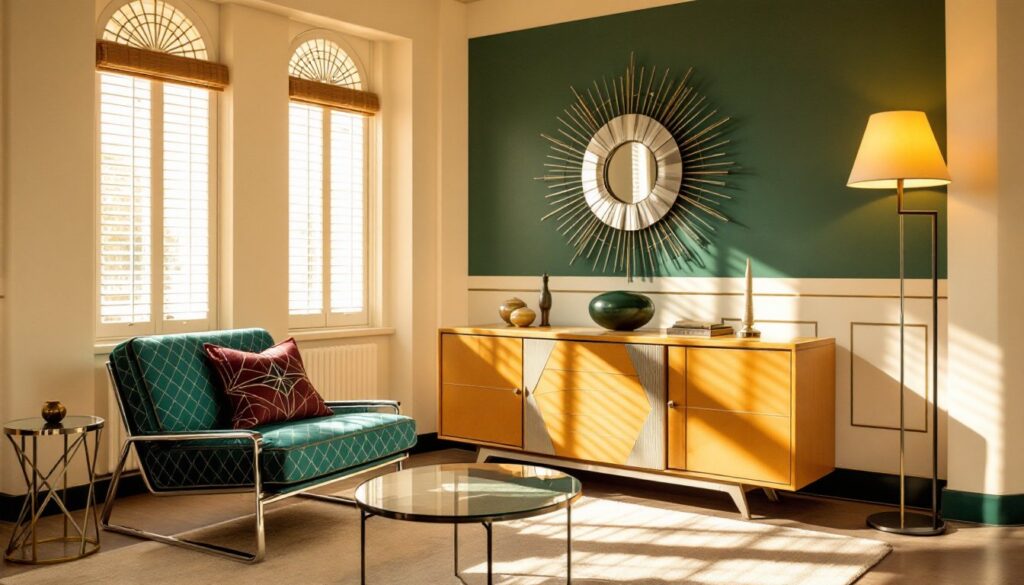
In homes, Art Deco appeared in sunburst mirrors, stepped or chevron-patterned rugs, chrome-and-glass cocktail tables, and lacquered cabinetry. Wall treatments featured flocked wallpapers with geometric patterns or simple horizontal stripes in contrasting colors. The aesthetic was unabashedly glamorous: it didn’t apologize for abundance or luxury, even during economic hardship. Art Deco appealed to upper-middle-class homeowners who wanted interiors that announced taste and modernity.
Streamline Moderne: The Future-Forward Aesthetic
As the 1930s progressed, Streamline Moderne emerged as a softer, more organic evolution. Influenced by industrial design, trains, ocean liners, and aeronautical shapes, this style featured curved lines, horizontal emphasis, and an illusion of motion even in stationary objects. Where Art Deco was all angles and symmetry, Streamline Moderne was flowing and asymmetrical.
Interiors incorporated curved furniture, horizontal banding on walls, glass block, and smooth surfaces. Chrome rails, tubular steel frames, and rounded edges dominated furniture design. The style felt more livable and less severe than Art Deco: it maintained glamour but introduced comfort and a hint of humor. This aesthetic proved hugely influential in commercial design, movie theaters, diners, and office buildings, but also trickled into residential spaces, particularly in bathrooms and kitchens where its hygienic, forward-thinking appearance suited the era’s aspirations.
Color Palettes And Materials That Defined The Decade
Color in the 1930s was bold and intentional. Unlike the muted palettes of the 1920s, the decade embraced jewel tones, metallics, and high-contrast combinations. Deep teals paired with cream, forest green with gold, burgundy with silver, and shocking pink with pale blue. Neutrals existed mainly as backgrounds: the goal was visual impact.
Black appeared frequently as a grounding or framing device, black lacquered furniture, black trim on walls, black baseboards that made colors pop. White and cream provided relief, often used on ceilings or as secondary walls. Metallics, chrome, brass, aluminum, and silver leaf, weren’t accents: they were primary elements, reflecting light and suggesting modern machinery.
Materials reflected the decade’s dual obsession with luxury and functionality. Lacquered wood (often blonde or natural with high-gloss finishes) dominated cabinetry and furniture. Chrome and nickel-plated steel appeared in everything from furniture legs to bathroom fixtures. Glass block, an industrial innovation, became decorative, used in interior walls, shower enclosures, and even cabinetry doors for visual interest without surrendering privacy. Bakelite (an early plastic) was molded into colorful handles, drawer pulls, and decorative accessories. Mirrors, beveled and plain, multiplied available light and enhanced perceived space. Fabrics featured geometric prints, bold stripes, and stylized florals, often in cotton or linen rather than velvet or silk, prioritizing durability and easy care.
Furniture And Architectural Features Of 1930s Interiors
Furniture from the 1930s breaks sharply from earlier decades. Pieces were lower, more horizontal, and often appeared to float above floors due to slender legs or recessed bases. This created an illusion of lightness and modernity even in substantial furniture.
Sideboards and credenzas featured geometric inlays, veneered fronts, and streamlined profiles, nothing fussy, everything functional. Coffee tables had glass tops over mirrored or chrome bases. Club chairs and sofas used tubular steel frames or tapered wooden legs in light woods. Upholstery favored geometric patterns and bold solid colors rather than florals. Beds often had headboards with stylized designs, sunbursts, chevrons, or horizontal banding in contrasting veneers.
Architecturally, built-in features replaced free-standing furniture where possible. Wall-mounted shelving in lacquered wood or metal, glass-fronted cabinetry, and geometric tile work (especially in bathrooms and kitchens) integrated design into the structure itself. Crown molding largely disappeared, replaced by simple cove ceilings or sharp, clean lines where walls met ceiling.
Doorways and passages featured fluted or reeded millwork, subtle geometric detail that suggested machine-made precision without being ornate. Hardware, knobs, pulls, and hinges, became visible, sculptural elements often in chrome or brushed nickel. Fireplaces, if present, featured simplified mantels in polished stone or wood with geometric surrounds. Windows lost heavy curtains in favor of simple drapery in solid colors or geometric patterns, often paired with horizontal blinds or simple roller shades.
How To Incorporate 1930s Design Into Your Modern Home
Restoring or creating a full 1930s interior works best in homes built during that era, but selective borrowing from the decade’s vocabulary translates beautifully into contemporary spaces.
Start with color. Paint an accent wall in a jewel tone, deep teal, forest green, or burgundy, and pair it with cream or soft gray walls. This immediately evokes 1930s boldness without requiring structural changes.
Layer in materials strategically. A chrome or brushed nickel mirror, glass-top table, or brass-framed shelving brings period character without overwhelming a modern room. Avoid mixing too many metallic finishes: stick to two, perhaps chrome and brass, or chrome and polished nickel.
Source period-appropriate furniture carefully. Authentic 1930s pieces vary enormously in quality and condition. Look for pieces with clean lines, tapered or tubular legs, and simple geometric details. Avoid reproductions that oversimplify the era’s complexity: a lacquered credenza with subtle inlay beats a crude geometric coffee table.
Wallpaper and textiles offer easy entry points. A geometric or chevron-patterned wallpaper on one wall, paired with solid colors elsewhere, captures the decade’s visual punch. Similarly, throw pillows in bold geometric prints or solid jewel tones on a contemporary sofa suggest 1930s sensibility without requiring period furniture.
Window treatments should be simple. Solid-colored panels in a bold color or subtle geometric print, paired with a sleek roller shade or minimal blinds, feel authentically 1930s and far more contemporary than ornate drapes.
The key is restraint and intentionality. The 1930s succeeded because designers made deliberate choices and executed them cleanly. Mixing random vintage pieces looks cluttered: curating a cohesive palette of color, materials, and geometric detail captures the era’s true spirit.