Setting up a home or small office workspace doesn’t require a contractor’s budget or a designer’s expense account. Whether someone is transitioning to remote work, launching a freelance side hustle, or simply carving out a focused corner for admin tasks, small office interior design on a tight budget is entirely achievable. The trick isn’t spending more, it’s spending smarter. By leveraging vertical space, choosing furniture that pulls double duty, and using strategic finishes like paint and lighting, even a cramped 100-square-foot nook can feel organized, professional, and pleasant to spend eight hours in. This guide walks through seven practical strategies that prioritize function over flashy accessories, keeping costs low while maximizing both space and productivity.
Key Takeaways
- Low budget small office interior design succeeds through strategic choices like vertical shelving, multi-functional furniture, and smart paint selections rather than expensive contractors or designers.
- Maximize vertical wall space with open shelving and corner units ($40–80) to keep storage organized and off limited desk surface without consuming floor area.
- Multi-functional furniture such as desks with built-in drawers, storage ottomans, and rolling cabinets justifies its footprint in tight quarters and improves both comfort and productivity.
- Layer lighting with desk lamps, floor lamps, and ambient strip lights ($15–80 total) to reduce eye strain and make small spaces feel larger and more inviting.
- Source budget-friendly pieces from second-hand markets, liquidation auctions, and big-box retailers to cut costs by 50–70% while prioritizing durability over aesthetics.
- Create visual zones using area rugs, accent wall paint, and strategic furniture placement to define a professional office space without expensive partitions.
Maximize Vertical Space to Expand Your Office Footprint
Small offices don’t have the luxury of spreading out horizontally, so going vertical is non-negotiable. Floor space is expensive real estate: wall space is free. Install open shelving units from wall studs (typically spaced 16 inches on center) using heavy-duty L-brackets rated for at least 25 pounds per shelf. This keeps books, storage bins, and reference materials off the desk while keeping them within arm’s reach.
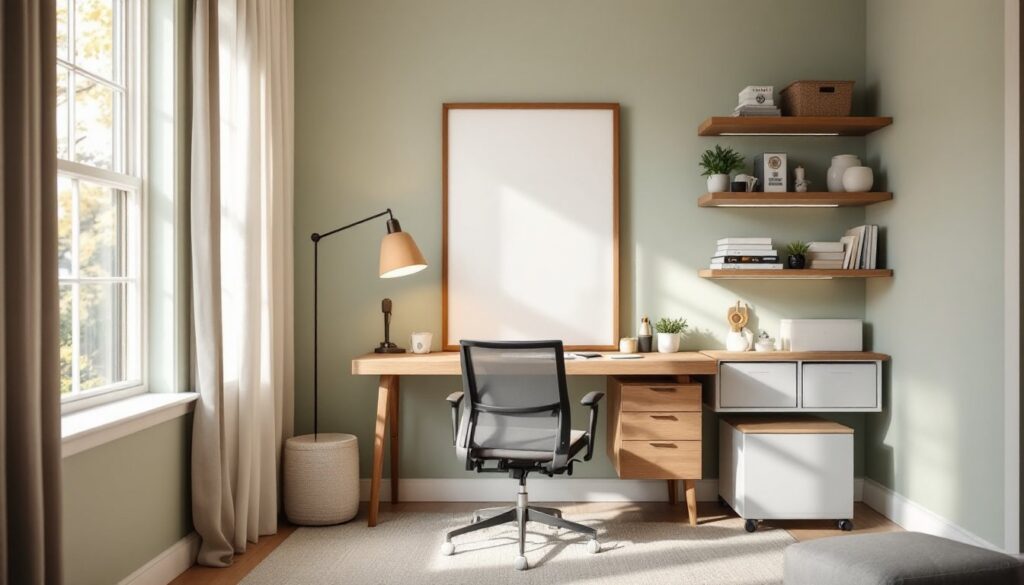
Corner shelving units maximize dead space that would otherwise sit empty. A 72-inch corner shelf kit (typically $40–80) transforms an overlooked corner into a storage powerhouse for office supplies, binders, and decorative items that double as visual interest. Wall-mounted cabinets with doors hide clutter while maintaining a clean sightline, crucial when video calls are part of the job.
Don’t forget above-door real estate. A 24-inch floating shelf installed 6 inches above a doorframe holds rarely accessed boxes or archives without consuming functional wall space. Use adjustable shelving where possible: as work evolves, storage needs shift, and flexibility costs nothing extra.
Choose Multi-Functional Furniture That Earns Its Place
In a small office, furniture must justify its footprint. A desk with built-in drawers and shelving is far smarter than a simple tabletop paired with a separate filing cabinet. Look for desks with pegboard back panels ($200–400), they provide organization without expanding the piece’s floor area.
A storage ottoman ($60–120) serves as both a footrest and a repository for under-desk supplies. Rolling filing cabinets on casters ($80–150) can tuck under a desk or be wheeled into a closet when not in active use. This mobility is key in tight quarters.
Consider a console desk (24–30 inches deep) instead of a traditional 60-inch office desk if the space truly doesn’t allow it. Modern console designs still include shelving and cable management, but they occupy half the footprint. Pair it with a wall-mounted monitor arm ($30–60) to free up another 6–8 inches of desk surface.
Seating matters, but it doesn’t have to be expensive. A basic ergonomic task chair ($80–150) is a one-time investment that pays dividends in back health. Buying the cheapest option risks months of discomfort, false economy. Conversely, a $600 luxury chair isn’t necessary: midrange models offer good adjustability and durability.
Leverage Paint, Lighting, and Mirrors for Big Visual Impact
Paint is the cheapest way to transform a space. Avoid white-on-white monotony. A soft sage, warm gray, or muted blue accent wall (one gallon of quality paint: $30–45) makes the room feel intentional without screaming “office.” Dark colors close in small spaces, so stick to mid-tone or light finishes: save dark accents for trim or a single statement wall.
Lighting does more than illuminate, it sets mood and expands perceived space. A single overhead fixture creates harsh shadows and fatigue. Layer it: add a desk lamp with a diffused shade ($25–50) to reduce glare, a floor lamp in the corner ($30–80) to create depth, and consider LED strip lights ($15–30) behind shelving for ambient glow. Task lighting over the desk prevents eye strain during long work hours: ambient lighting around the perimeter makes the room feel larger.
Mirrors are magic in small spaces. A large framed mirror ($40–100) opposite a window reflects natural light and creates an illusion of depth. Avoid mirror tiles or cheap plastic-backed options, they cheapen the space. One quality mirror beats five mediocre ones.
Source Budget-Friendly Furniture and Decor Wisely
Where to Find Affordable Pieces
Second-hand office furniture is plentiful and underpriced. Estate sales, office liquidation auctions, and Facebook Marketplace often have solid wood desks, filing cabinets, and bookshelves at 50–70% below retail. Inspect carefully: solid wood can be refinished: particleboard is harder to salvage. Check for woodworm, water damage, or structural weakness before committing.
Big-box stores like IKEA, Wayfair, and Amazon offer no-frills options that work fine in budget scenarios. A basic storage unit from these retailers ($150–300) might not last 20 years, but it costs a fraction of solid hardwood alternatives and fills the gap while a business stabilizes.
Local office supply outlets and returning-customer sections of furniture stores sometimes carry floor models, returns, or slight cosmetic damage at significant markups. A chair with a small fabric scuff sells for $120 instead of $300, functional and nearly invisible from across the room.
When buying new, prioritize durability over aesthetics. A $200 desk that lasts eight years costs $25 per year: a $80 desk that warps after two years costs $40 per year. Solid wood, metal frames, and quality drawer slides are worth the extra cash.
Create Zones Without Expensive Partitions
Partitions and room dividers run $150–500 and eat floor space. Instead, define zones using furniture placement, area rugs ($30–80), and visual cues. A strategically placed bookshelf acts as a divider between a work zone and the rest of a room without closing it off.
Area rugs define territory. A 5-foot-by-7-foot rug under the desk creates a visual boundary that signals “this is the work zone” without a wall. Layered rugs (a smaller accent rug atop a larger base rug) add dimension for minimal cost.
Paint or wallpaper a single wall to anchor the office area within a larger room. A bold color or subtle pattern ($20–50 in paint or peel-and-stick wallpaper) signals a functional space change without structural work.
Cabinets with opaque doors hide clutter and reinforce the zone’s purpose. Positioning the desk to face outward (away from the wall, if space allows) makes the office feel separate from behind-the-scenes storage and supplies.
Conclusion
Small office interior design on a tight budget succeeds through strategic choices, not sacrifice. Maximize vertical real estate, select furniture that serves multiple purposes, and use paint, lighting, and mirrors to expand the perceived space. Source wisely from second-hand and budget retailers, and create visual zones without expensive partitions. The result: a professional, organized workspace that cost far less than hiring a designer and delivers genuine comfort for eight-plus hours of daily work.